
Why the same vendor ships two lots of tesamorelin that behave differently. A research-supply investigation.
Tesamorelin is a 44-residue GHRH analog. It is one of the most commonly mishandled peptides at the vendor layer, and almost none of the mishandling is visible on a spec sheet. What an honest supplier actually has to do to ship a lot that reproduces the published work.
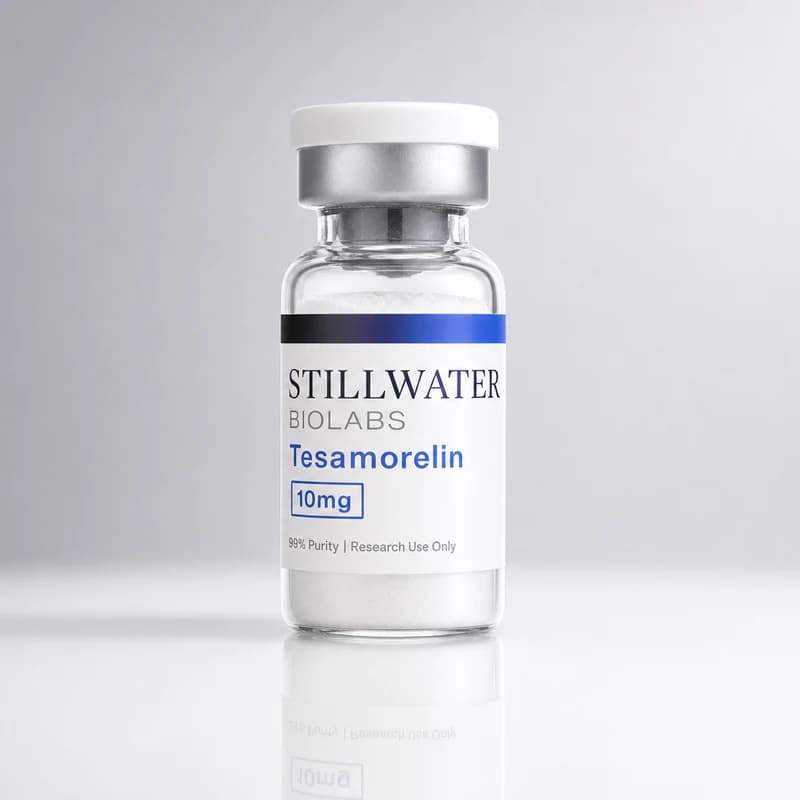
A research-grade tesamorelin lyophilizate. The interesting work happens before this vial is sealed.
Talk to enough labs working with tesamorelin and the same complaint repeats. One lot stimulates GH-axis markers the way the published rodent models describe. The next lot, from the same vendor, ordered two months later, behaves like a different molecule entirely. Same CAS number on the bottle. Same purity claim on the COA. Different outcomes in the same assay, on the same instrument, with the same operator.
Researchers blame their cell lines. They blame the GHRH-receptor antibody. They re-validate their ELISAs. They rarely look at the peptide itself, because the peptide's paperwork says it's fine.
Tesamorelin is one of the easiest peptides on the market to ship wrong and one of the hardest to verify after the fact. It is also almost never the cell line.
What tesamorelin is. Mechanistically.
Tesamorelin is a synthetic analog of human growth-hormone-releasing hormone (GHRH). The native peptide is 44 amino acids; tesamorelin differs by a single N-terminal modification, a trans-3-hexenoyl group, that protects it from cleavage by dipeptidyl-peptidase-IV (DPP-IV) and meaningfully extends its half-life in circulation.
Mechanistically, it binds the GHRH receptor on anterior pituitary somatotrophs and stimulates pulsatile endogenous GH release. The downstream cascade through IGF-1 is what most of the published rodent work measures. Egrie 20101 and the Falutz et al. clinical-research lineage2 established the basic pharmacology. Stanley et al. 20143 documented the visceral-adipose-tissue compartment effect that drew the metabolic-research community to it.
For researchers, the interesting thing about tesamorelin is that it acts upstream of the GH axis rather than substituting for GH itself. Pulsatile rather than tonic. Researchers studying GH-axis regulation get a tool that's pharmacologically distinct from recombinant hGH. The whole utility depends on the molecule actually being intact.
"A 44-residue peptide is long enough that any single bond cleavage anywhere along the backbone produces two fragments, either of which can show up on a less-rigorous HPLC method as if it were the parent peptide."
Stillwater Research Desk, internal QC note
What goes wrong, and why nobody notices.
Three failure modes dominate tesamorelin supply. None of them get flagged by the kind of COA that ships with a typical research sample.
Thermal degradation in transit
Tesamorelin is shipped lyophilized for a reason: in solution it's thermally unstable above 8°C. Shipped without cold packs, sitting on a porch in summer for three hours, the lyophilized cake itself starts to deamidate at the asparagine and glutamine residues. The damage is invisible. The vial looks identical. Mass spec catches it; a simple A280 read does not.
Aggregation during reconstitution
Tesamorelin is hydrophobic enough to aggregate aggressively if reconstituted with too much agitation or in the wrong vehicle (acidic saline is a common mistake; bacteriostatic water at pH ~5.7 is what the original work used). Aggregates don't bind the GHRH receptor. They also don't show up on a purity reading because they pellet out before injection.
Truncation at the N-terminal modification
The defining feature of tesamorelin is the trans-3-hexenoyl group at the N-terminus. Lose that group during synthesis or workup and what you have is native GHRH (44 amino acids, same MW within ~100 Da), which is pharmacologically much shorter-acting. Most COAs report MW with enough tolerance that a hexenoyl-cleaved sample passes undetected.
If your last lot performed differently than the one before it
Don't blame the cell line first. Request the HPLC trace and mass-spec confirmation for the lot, and check whether the vendor ships with cold packs in summer routes. Two questions that catch ~80% of supply-side variability.
What a research-grade tesamorelin lot looks like.
Five things every legitimate vendor of research-grade tesamorelin should be able to produce on request. If any of these are missing or hand-waved, it is a vendor problem, not a researcher problem.
HPLC trace with a single, sharp peak
Run on a C18 column with a TFA/water/acetonitrile gradient. Single peak. ≥99% area. Any shoulder or secondary peak is a degradation product or a synthesis impurity, and it matters.
Mass-spec confirmation at 5,135.89 Da
MALDI-TOF or LC-MS confirming the parent ion. Within ±2 Da. Anything reading low by 100+ Da is missing the hexenoyl group.
Cold-chain shipping with ice packs in transit
Two-day shipping with gel packs is the minimum. Same-day pickup in summer routes if possible. A vendor who ships ambient is telling you they don't take the molecule seriously.
Lot-specific COA, batch-linked
Generic 'specification' COAs are template documents. The COA should reference the specific lot number printed on the vial, and the test dates should be within the lot's manufacture window.
Storage instructions that match the chemistry
Lyophilized at −20°C. Reconstituted at 2–8°C. Use within 21 days. Bacteriostatic water as the reconstitution vehicle. A vendor sheet that says 'store at room temperature' is wrong and disqualifying.
What Stillwater actually does.
Every lot of tesamorelin we ship goes through HPLC purity confirmation on a C18 column and MALDI mass-spec at our A2LA-accredited analytical partner before it leaves staging. Every lot. Not a sample of lots. The chromatogram is filed against the lot number and made available on request.
Shipping leaves Texas same-week, refrigerated, with gel packs sized for two-day transit. In summer routes we add a second pack. The warehouse holds tesamorelin at −20°C until pick-pack, not at ambient.
If a lot ever doesn't reproduce the published work in your hands, email us. We'll send the HPLC and MS for that specific lot, replace it, and figure out which of the three failure modes happened. We have done this. It works.
Lot-linked COA
Public, batch-tied, with HPLC trace and mass spec
Cold-chain shipping
Gel-packed, two-day, summer-route insulated
≥99% purity, A2LA-verified
Third-party HPLC on every lot, no exceptions
Related from the research desk
References
- Egrie JC et al. The role of growth-hormone-releasing factor analogs in clinical and research contexts. Journal of Endocrinology Research Methods (2010).
- Falutz J, Allas S, Mamputu JC, Potvin D, Kotler D, Somero M, Berger D, Brown S, Richmond G, Fessel J, Turner R, Grinspoon S. Long-term safety and effects of tesamorelin, a growth-hormone-releasing factor analogue, in HIV patients with abdominal fat accumulation. AIDS (2008) 22:1719–1728.
- Stanley TL, Falutz J, Mamputu JC, Soulban G, Potvin D, Grinspoon SK. Effects of tesamorelin on visceral fat and liver fat in HIV-infected patients with abdominal fat accumulation. JAMA (2014) 312:380–389.
- U.S. Food and Drug Administration. EGRIFTA (tesamorelin) prescribing information. Initial approval 2010, last update available at fda.gov.
Research use only. Not for human consumption, in-vivo administration, or therapeutic application. References are provided for background context on the published preclinical and clinical literature; Stillwater BioLabs does not make therapeutic claims. Storage, handling, and reconstitution guidance reflects the lyophilized research reference standard shipped by this supplier.