
Thirty Years Of BPC-157 Research. And A Supply Chain That Hasn't Kept Up.
The story starts in 1993 with a fragment the human stomach already makes, and a Croatian pharmacology lab that spent the next three decades refusing to let it disappear into the background. What they've published and what's actually reaching researchers' labs today have quietly drifted apart.
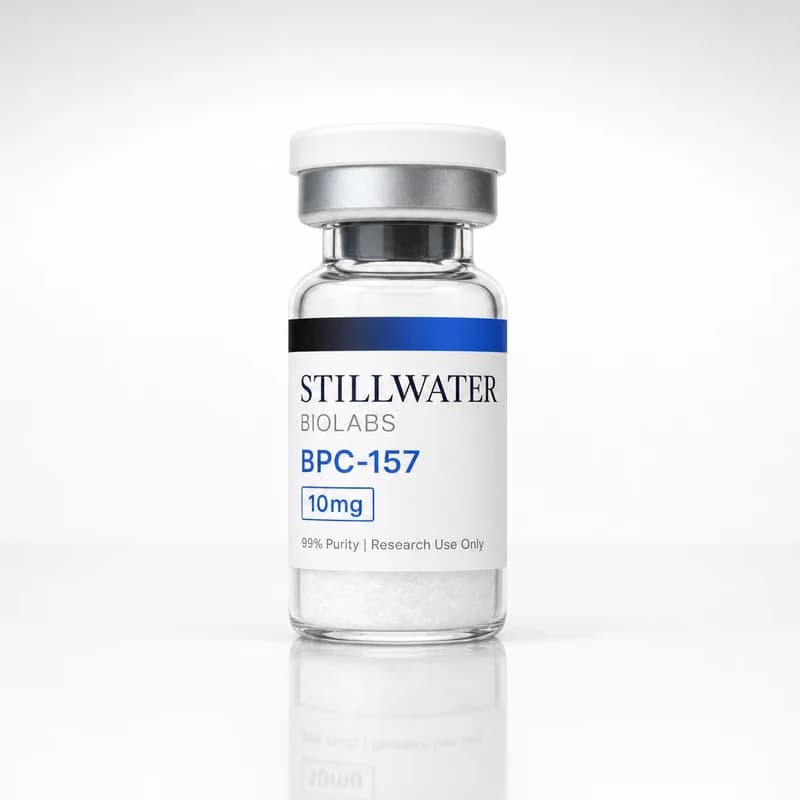
Research-grade BPC-157. Acetate salt, ≥99% HPLC-verified, cold-chain stored.
In 1993, a pharmacology team at the University of Zagreb isolated a 15-amino-acid fragment from human gastric juice and ran into something they didn't expect. The fragment held together in conditions that broke down every other peptide they tested. It crossed membranes intact. It showed up unchanged in serum an hour after administration. By every ordinary rule of peptide chemistry, it should have disintegrated. It didn't.
They named it Body Protection Compound-157, or BPC-157, and started publishing.
Thirty-two years and roughly a hundred peer-reviewed papers later, the Zagreb group's BPC-157 record is one of the densest single-compound preclinical bodies of work in regenerative pharmacology. Tendon-transection rat models. Gastric ulcer assays. Angiogenesis studies in endothelial cells. Nitric-oxide pathway experiments. A whole family of wound-healing models. If you're a researcher working in any of these areas, BPC-157 is hard to avoid, and usually shouldn't be.
And yet. Walk into ten research labs running BPC-157 protocols today and at least three of them are working with material that doesn't match what the Zagreb team has been publishing. Wrong salt form. Broken cold chain. Or both. This piece is a short accounting of why that happens. And what a researcher should check before the next order ships.
A literature with a single center of gravity.
Most drug-candidate research fans out across dozens of independent groups working from competing starting points. BPC-157 is different. A quick citation-graph pull on PubMed turns up Dr. Predrag Sikiric or one of his long-time Zagreb collaborators on the majority of the peer-reviewed record. For a single molecule that's been studied for three decades, that concentration is unusual, and worth naming up front.
The concentration creates a strength and a question at the same time. The strength: the methods are consistent across the published work. Protocols look familiar from paper to paper. Dose ranges cluster. Animal models are handled the same way.
The question: can external labs reproduce the effect sizes? Some can. Some can't. And when we talk to the ones who can't, a recurring thread shows up before anyone starts questioning the original research. It's the compound they're working with.
"Effect sizes in BPC-157 work are unusually tight across the Zagreb record. When external labs fail to replicate, the first thing I'd check is the compound form, not the protocol."
Paraphrased from a research-supply conversation, 2026
Two BPC-157s, one SKU.
This is the issue that trips up the most researchers. BPC-157 can be supplied as an acetate salt or as an arginate salt. The majority of the Zagreb group's published studies used the acetate form. A meaningful fraction of the material circulating through research-supply channels is the arginate form. It's often shipped under the generic label "BPC-157" with no salt-form notation on the packaging or the Certificate of Analysis.
The two forms aren't interchangeable. Solubility differs, stability profiles differ, and how the compound behaves in animal-model work differs enough that protocols developed against the acetate form don't translate directly. A lab attempting to replicate a Sikiric protocol using the arginate salt is, often without knowing it, working with a different compound.
If your COA doesn't list the salt form
That's the first flag. Any lab-grade BPC-157 CoA should explicitly state the salt form alongside the molecular weight. If it doesn't, you don't actually know what you're about to dose into your model system.
The stability myth.
BPC-157's origin story is inseparable from its gastric-juice resistance. The Zagreb group named it "Body Protection Compound" partly because the fragment held structural integrity in conditions that normally break down peptides fast. That's a real property.
It's also the source of a persistent misconception in research channels: that because BPC-157 survives gastric juice, it's effectively stable everywhere. It isn't.
Lyophilized BPC-157 stored at -20°C holds indefinitely. Reconstituted in an aqueous laboratory solvent at 2-8°C, it's stable for roughly 28 days. Sitting at room temperature in a shipping box for a week of summer transit is a different situation entirely. Vendors who don't cold-chain their material (and there are many) are rolling the dice on the researcher's experiment, not their own.
Three areas where the preclinical data keeps stacking.
Assuming the compound is the correct salt form and the cold chain held, three research areas have produced the most reproducible findings:
Tendon and ligament repair in rodent models
Chang et al. (2011) showed accelerated Achilles tendon repair in rats after transection3. Krivic et al. (2006) documented comparable effects in ligament detachment4. The mechanism involves growth hormone receptor upregulation on tendon fibroblasts, a finding extended by Hsieh et al. (2017)5.
Gastrointestinal protection
The Zagreb group's foundational work: ulcer models (alcohol-, NSAID-, stress-induced), mucosal healing, reduced lesion area, accelerated epithelial restitution1. This is the most data-dense area of the BPC-157 literature.
Angiogenesis via the nitric oxide system
Seiwerth, Brcic, and collaborators have documented VEGFR2 upregulation and nitric oxide pathway modulation in endothelial-cell assays and rodent wound models6. The angiogenic signature is mechanistically distinct from classical growth-factor pathways.
Acetate-salt BPC-157 · 5mg
HPLC-verified ≥99%. Mass spec confirmed. Salt form explicitly stated on every COA.
Why supplement-channel BPC-157 keeps failing labs.
Four failure modes we see repeatedly when researchers arrive at Stillwater after a bad sample:
Wrong salt form, unlabeled
Arginate shipped as 'BPC-157' with no salt notation on the COA. Protocols developed against acetate-form research don't translate directly.
No cold-chain during transit
Lyophilized material sitting in a non-insulated box at summer-truck temperatures for 3-5 days. Loss of structural integrity by the time it reaches the lab.
Purity claims without HPLC trace
A COA that says ≥99% but no underlying chromatogram. Without the actual data, the number is a marketing claim, not a quality signal.
Sourcing from fitness-industry channels
Wholesale supply chains built for consumer-channel resellers aren't set up for research reproducibility. Lot tracking, batch-linked COAs, and cold-chain integrity are usually afterthoughts.
"We've had researchers arrive after three consecutive 'BPC-157' orders that turned out to be arginate-form material. Their tendon repair data was soft. They assumed the literature was soft."
Stillwater BioLabs operations notes
What a legitimate research-grade BPC-157 sample should actually have.
The checklist a researcher should run before trusting any sample for published work:
Purity verified via reversed-phase HPLC
≥99% target with the chromatogram published on a batch-linked COA.
Mass spec confirmation of 1419.53 Da
ESI-MS or MALDI-TOF. Monoisotopic mass of the parent peptide, plus salt form noted separately.
Acetate salt form, explicitly stated
Matches the Zagreb literature. If the COA doesn't say, it's not research-grade for this purpose.
Full 15-residue sequence verification
Gly-Glu-Pro-Pro-Pro-Gly-Lys-Pro-Ala-Asp-Asp-Ala-Gly-Leu-Val. Partial or substituted sequences are a red flag.
Cold-chain shipping
Stored at -20°C pre-ship. Shipped 2-day air with temperature-controlled packaging.
Public, lot-specific Certificate of Analysis
Not on request. Published and linkable. Anyone can verify the specific lot they received.
How Stillwater BioLabs handles it.
We ship the acetate salt form, which is what the Zagreb literature used. Every batch is HPLC-verified to ≥99%, mass-spec confirmed to a monoisotopic mass of 1419.53 Da, and sequence-verified across all fifteen residues before it leaves our facility.
Material ships cold-chain from -20°C storage to the researcher's door via UPS 2nd Day Air, with temperature-controlled packaging for summer months at no additional cost. The batch-linked Certificate of Analysis is public and searchable by lot number. You can look up the exact batch you're receiving before you place the order, and the COA can't be edited after the fact.
This is what research-grade supply should look like for a compound with 30 years of preclinical literature behind it. We just hold the standard.
Production runs in finite batches. Each lot carries its own COA with the full HPLC chromatogram and measured-quantity report from an A2LA-accredited independent lab. Once a lot sells through, the next lot gets a new number and a new published record.
Two paths, both with a cost.
A researcher running BPC-157 experiments has two practical options.
The first: order from the cheapest source, accept whatever salt form shows up, skip the cold-chain check, and absorb whatever variance ends up in the data. The sticker price is lower. The reproducibility cost compounds across the project. And you don't always know that until the paper comes back from review with questions about effect sizes.
The second: pay for verified material that matches the published research. Acetate salt, HPLC-confirmed, mass-spec identified, sequence-verified, cold-chain delivered, batch-linked to a public COA. The sticker price is higher. The data-quality cost is what it should be, which is zero.
What clean supply looks like, downstream.
A researcher working with correctly-identified, correctly-stored, properly-verified BPC-157 shouldn't have to think about the supply layer. The salt form is right. The mass is right. The COA matches the lot in hand. The only variables in the experiment are the ones the researcher designed in.
That's the bar. That's what the Stillwater BPC-157 lot in your lab should feel like.
Researcher FAQ
Acetate vs arginate: why does the salt form matter?
Most of the Sikiric group's three-decade body of BPC-157 research used the acetate salt form. Solubility, stability, and how the compound behaves differ between the two forms. A protocol developed against the acetate-form research may not translate directly to arginate-form material. We ship acetate exclusively. The COA states it explicitly.
How do I verify sequence identity?
The full 15-residue sequence is Gly-Glu-Pro-Pro-Pro-Gly-Lys-Pro-Ala-Asp-Asp-Ala-Gly-Leu-Val. Mass spec should show a parent-peptide mass of 1419.53 Da for the free acid. Our COAs include the MS trace alongside the HPLC chromatogram. Any reputable research-supply CoA should provide both.
Storage and stability protocol?
Lyophilized: stable at -20°C indefinitely. After reconstitution in an aqueous laboratory solvent: stable at 2-8°C for approximately 28 days. Freeze-thaw cycles should be minimized. Aliquot on reconstitution if long-term storage of the working solution is needed.
What solvent for reconstitution?
An aqueous laboratory solvent is standard for research work. BPC-157 acetate is highly soluble at physiological pH. Avoid strong reducing agents or anything that could break down peptide bonds unnecessarily.
Do you ship internationally?
United States only, currently. Cold-chain logistics and regulatory framework vary significantly across jurisdictions and we don't ship where we can't guarantee the chain stays intact.
Is this intended for human use?
No. Strictly research use only. In-vitro and animal-model preclinical work. Not for human or animal consumption, therapeutic, diagnostic, or any clinical application. See our Research Use Only Policy.
References
- Sikiric P, Seiwerth S, Rucman R, et al. (2010). Stable gastric pentadecapeptide BPC 157: novel therapy in gastrointestinal tract. Current Pharmaceutical Design, 16(10), 1224-1234.
- Sikiric P, Seiwerth S, Rucman R, et al. (1999). Pentadecapeptide BPC 157 positively affects both non-steroidal anti-inflammatory agent-induced gastrointestinal lesions and adjuvant arthritis in rats. Journal of Physiology (Paris), 91(3), 113-122.
- Chang CH, Tsai WC, Lin MS, Hsu YH, Pang JH. (2011). The promoting effect of pentadecapeptide BPC 157 on tendon healing involves tendon outgrowth, cell survival, and cell migration. Journal of Applied Physiology, 110(3), 774-780.
- Krivic A, Anic T, Seiwerth S, Huljev D, Sikiric P. (2006). Achilles detachment in rat and stable gastric pentadecapeptide BPC 157: promoted tendon-to-bone healing. Journal of Orthopaedic Research, 24(5), 982-989.
- Hsieh MJ, Liu HT, Wang CN, et al. (2017). Therapeutic potential of pro-angiogenic BPC157 is associated with VEGFR2 activation and upregulation. Journal of Molecular Medicine, 95(3), 323-333.
- Seiwerth S, Brcic L, Vuletic LB, et al. (2013). BPC 157 and blood vessels. Current Pharmaceutical Design, 20(7), 1121-1125.
Further reading
BPC-157: Mechanisms of Cytoprotection and Angiogenesis
Blog · Stillwater BioLabs Research
TB-500 / Thymosin Beta-4: Actin Sequestration and Tissue Repair
Blog · Stillwater BioLabs Research
The Quiet Problem With Most Copper Peptide Samples (GHK-Cu)
Stillwater Research Desk · Investigation
BPC-157 product page: variants, COA, specs
Stillwater BioLabs · Research Catalog
For Research Use Only. All content is for educational and research purposes only. Preclinical and in-vitro studies cited are from published peer-reviewed literature. Products sold by Stillwater BioLabs are intended strictly for laboratory research and are not for human or animal consumption, therapeutic, diagnostic, or any other clinical or commercial use.