
The Quiet Problem With Most Copper Peptide Samples. What Researchers Need To Verify Before Ordering.
GHK-Cu is the most-studied copper tripeptide in regenerative research. It's also the most commonly mishandled at the vendor layer. A research-supply investigation into why inconsistent findings are following researchers into their labs, and what to check before the next order goes out.
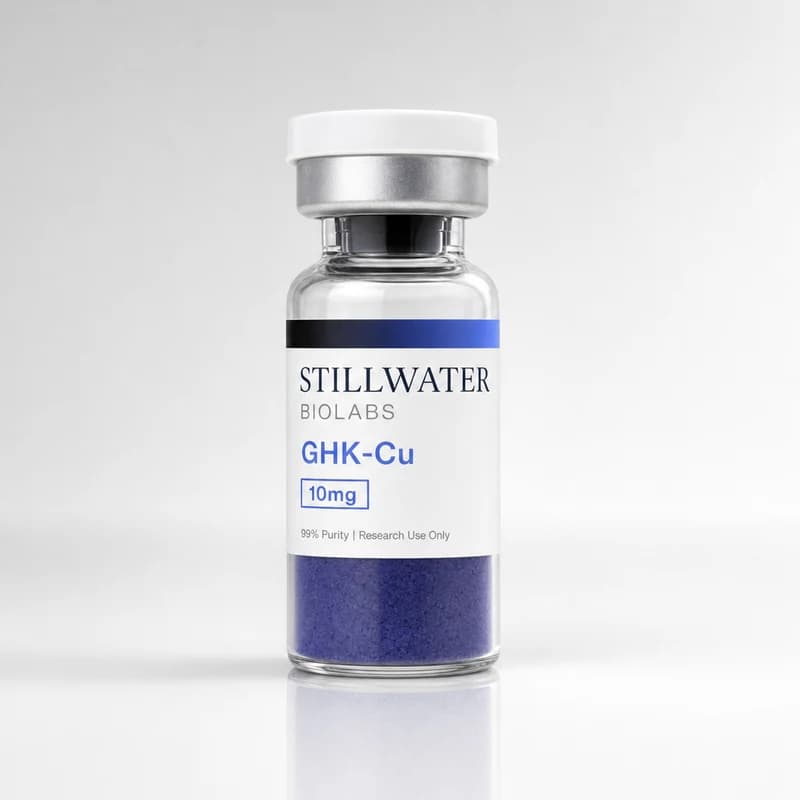
Research-grade GHK-Cu in its characteristic deep blue-violet form. The color is the first test.
Walk the peptide supplier space long enough and you start noticing the same complaint from labs working with copper tripeptide. The samples arrive. The paperwork looks fine. But the results don't match what the published research shows. Collagen assays come in softer than Maquart 1988. Fibroblast gene-expression arrays under-express the genes Pickart's 2012 paper flagged. Something is missing.
In a lot of these cases, something ismissing. It's the copper.
Unlike most peptide research compounds, GHK isn't meaningful without its copper(II) partner. The native, physiologically-active molecule is the glycyl-histidyl-lysine tripeptide coordinated with a copper ion. That complex is what modulates ~4,000 genes2, what is studied in collagen/ECM assay models, what modulates in-vitro wound-closure assay kinetics in rodent cell-culture systems. Strip the copper and you're left with an inactive version of the peptide. It looks like GHK on a spec sheet and fails to reproduce any of the peer-reviewed work that defines the compound.
The color is the tell.
Pure GHK is the free tripeptide without its copper, and it's a white powder. GHK-Cu, with copper(II) properly coordinated, is a deep royal blue to blue-violet. The color comes from d-d electronic transitions in the copper-nitrogen coordination sphere. The shade is so distinctive that senior medicinal chemists can assess whether a sample is likely real just by eyeballing it.
A meaningful fraction of the GHK-Cu being sold into research channels today is white or pale-gray. It's been lyophilized without proper copper incorporation, or the copper has been lost during aggressive purification, or it was never added in the first place. The sample sheet says "GHK-Cu." The sample, mechanistically, is not.
If your GHK-Cu arrived white or off-white
You almost certainly don't have a biologically active copper complex. It might be perfectly pure GHK peptide. But the preclinical data that draws researchers to this molecule depends entirely on the copper coordination being intact.
"In one analysis, GHK-Cu modulated the expression of roughly 31% of the human genome (approximately 4,000 genes) either upward or downward in fibroblast cell cultures."
Pickart & Margolina (2012), BioMed Research International2
What researchers are actually studying.
GHK was first isolated from human plasma by Loren Pickart in 1973, in work published in Nature New Biology1. Over the next five decades, it became one of the most densely characterized bioactive peptides in regenerative biology. Major contributions have come from Pickart's group, Maquart's lab at the University of Reims, and dozens of independent research teams across dermatology, oncology, and geroscience.
What makes GHK-Cu scientifically interesting is that three amino acids and a copper ion carry a signaling program that touches a large fraction of the transcriptome. The peptide operates at three distinct cellular layers. That's unusual, and it's why the published research has gotten so broad:
Gene expression modulation
Up-regulates DNA repair and extracellular matrix genes. Down-regulates inflammatory and apoptotic pathways. Documented across multiple fibroblast array studies.
Tissue scaffold remodeling
Stimulates synthesis of collagen I, III, and IV, elastin, decorin, and glycosaminoglycans while modulating metalloproteinase activity. Organized, multi-protein remodeling rather than a single-gene effect.
Redox regulation
Elevates superoxide dismutase, glutathione peroxidase, and catalase activity. Chelates iron and suppresses lipid peroxidation. That's a two-mechanism antioxidant footprint simple radical scavengers don't match.
Plasma concentrations, meanwhile, decline with age. From roughly 200 ng/mL at age 20 to about 80 ng/mL by age 607. That's a 60% drop in native signaling tone. It has drawn the geroscience community into the molecule from a different research angle entirely.
HPLC-verified GHK-Cu · 50mg
Every batch tested for purity and copper coordination. Public batch-linked COA for every lot.
Three findings the preclinical data keeps producing.
Collagen/ECM assay signals stack in aged-donor cultures
Maquart's 1988 FEBS Letters paper3 remains the reference for fibroblast collagen response to GHK-Cu. Two- to six-fold increases in type I collagen expression, with parallel bumps in elastin, decorin, and glycosaminoglycans. Aged-donor fibroblasts (the kind that matter for skin remodeling and geroscience research) showed the strongest response. That tracks with the hypothesis that restoring signaling input to senescent cells partially recovers their matrix-synthesis program.
Wound closure speeds up in rodent and rabbit models
The Canapp 2003 Veterinary Surgery study5 is one of the cleaner reads on topical GHK-Cu in ischemic wound models: accelerated closure, reduced scar tissue, earlier angiogenic infiltration. The angiogenic component is mechanistically distinct from standard growth-factor-mediated pathways and appears to involve direct endothelial migration stimulation.
Antioxidant enzyme upregulation is consistent across tissue types
SOD, glutathione peroxidase, and catalase all move in the expected direction following GHK-Cu administration in both fibroblasts and hepatocytes6. Combined with the iron chelation activity, which suppresses Fenton-reaction radical generation upstream, you end up with a two-mechanism antioxidant profile that simple scavenger compounds can't reproduce.
Why supplement-grade and bulk sources keep failing labs.
Three failure modes we see repeatedly when researchers arrive at Stillwater after a bad sample:
Copper coordination incomplete or absent
The tell-tale white powder. Often from vendors who lyophilize GHK without adequate copper preincorporation, or who strip copper during aggressive desalting. Mechanistic activity lost.
Purity claimed but not published
A COA that says ≥99% but no underlying HPLC chromatogram from an accredited lab. Without the actual chromatogram and lot-specific report, the number is a marketing claim, not a quality signal.
Cold-chain lapses
Reconstituted GHK-Cu is stable at 2-8°C for ~28 days. Lyophilized material degrades if it spends time at room temperature during transit. Many supply chains can't confirm cold-chain integrity.
What a legitimate research-grade GHK-Cu sample should actually have.
A checklist researchers should run before they trust a sample for published work:
Purity verified via reversed-phase HPLC
≥99% target with the chromatogram published on a batch-linked COA.
Quantity verified by HPLC
The lab measures the actual fill against the labeled mg, so you know what's in the vial isn't short of what's on the label.
Correct color signature
Deep royal blue to blue-violet. A white or pale-gray sample has lost copper. Demand replacement.
Cold-chain from facility to researcher
Stored at -20°C pre-ship. Shipped 2-day air with temperature-controlled packaging.
Public, lot-specific Certificate of Analysis
Not on request. Published and linkable. Anyone can verify the specific lot they received.
How we approach GHK-Cu at Stillwater BioLabs.
We started Stillwater because we got tired of the peptide research market's ambient dishonesty. The name on the label matters. The label should represent the actual molecule in the vial.
Every batch of our GHK-Cu is HPLC-verified to ≥99%, mass-spec confirmed for both peptide identity and copper coordination, visually inspected for the correct blue-violet color signature, and shipped cold-chain from -20°C storage to the researcher's door. The batch-linked Certificate of Analysis is public and searchable by lot number. You can look up the exact batch you're receiving before you place the order, and we don't get to edit it after the fact.
It's an unremarkable operating standard. We just hold it.
"The batch-linked COA isn't on request. It's published, linkable, and lives next to the product page. Researchers should be able to verify the lot before the order goes out."
Stillwater BioLabs operating principle
We run production in finite batches and we make limited batches. When a lot sells through, the next lot gets a new COA and a new lot number. That's why lot-linked COAs matter.
Two paths, both with a cost.
A researcher running GHK-Cu experiments has two options.
The first is to order from the cheapest source, skip the COA check, accept whatever shows up in the vial, and live with whatever variance ends up in the data. The sticker price is lower. The reproducibility cost compounds over the project.
The second is to pay for verified material. HPLC-confirmed, mass-spec identified, cold-chain delivered, batch-linked to a public COA. The compound matches the molecule the published research is describing. The sticker price is higher. The data-quality cost is what it should be, which is zero.
What clean supply looks like, downstream.
A researcher working with properly-coordinated, verified GHK-Cu shouldn't have to think about the supply layer. The color is right, the purity is right, the COA is linked to the lot, and the only variables in the experiment are the ones the researcher actually designed in.
That's the bar we set, and that's what the Stillwater GHK-Cu lot in your lab should feel like.
Researcher FAQ
How do I verify the copper coordination is intact?
Three cues, in order: visual color check (deep blue-violet, not white), the mass-spec trace on the COA (should show the Cu-peptide complex mass, not just the peptide), and UV-Vis absorbance at ~525 nm if you have a spectrophotometer on hand.
What happens if I receive a sample that looks wrong?
Contact us with the lot number. If the color or purity is off, we replace the lot at no additional cost. We publish every batch COA before shipping; any discrepancy is on us.
What's the storage protocol?
Lyophilized: -20°C, indefinitely stable. Reconstituted: 2-8°C in aqueous laboratory solvent, use within 28 days. Protect from direct light. The copper coordination is photosensitive over extended periods.
What solvents work for reconstitution?
An aqueous laboratory solvent is standard for research work. GHK-Cu is soluble at physiological pH. Avoid strong reducing agents or chelators in the buffer. They'll strip the copper.
Do you ship internationally?
United States only, currently. Cold-chain logistics and regulatory framework vary significantly across jurisdictions, and we don't ship where we can't guarantee the chain stays intact.
Is this intended for human use?
No. Strictly research use only. In-vitro and animal-model preclinical work. Not for human or animal consumption, therapeutic, diagnostic, or any clinical application. See our Research Use Only Policy.
References
- Pickart L, Thaler MM. (1973). Tripeptide in human serum which prolongs survival of normal liver cells and stimulates growth in neoplastic liver. Nature New Biology, 243(124), 85-87.
- Pickart L, Margolina A. (2012). Regenerative and protective actions of the GHK-Cu peptide in the light of the new gene data. BioMed Research International, 2012, 324832.
- Maquart FX, Pickart L, Laurent M, Gillery P, Monboisse JC, Borel JP. (1988). Stimulation of collagen synthesis in fibroblast cultures by the tripeptide-copper complex glycyl-L-histidyl-L-lysine-Cu2+. FEBS Letters, 238(2), 343-346.
- Canapp SO, Farese JP, Schultz GS, et al. (2003). The effect of topical tripeptide- copper complex on healing of ischemic open wounds. Veterinary Surgery, 32(6), 515-523.
- Beretta G, Arlandini E, Artali R, Anton JM, Maffei Facino R. (2008). Acrolein sequestering ability of the endogenous tripeptide GHK. Journal of Pharmaceutical and Biomedical Analysis, 47(3), 596-602.
- Pickart L, Vasquez-Soltero JM, Margolina A. (2015). GHK-Cu peptide as a natural modulator of multiple cellular pathways in skin regeneration. BioMed Research International, 2015, 648108.
Further reading
For Research Use Only. All content is for educational and research purposes only. Preclinical and in-vitro studies cited are from published peer-reviewed literature. Products sold by Stillwater BioLabs are intended strictly for laboratory research and are not for human or animal consumption, therapeutic, diagnostic, or any other clinical or commercial use.