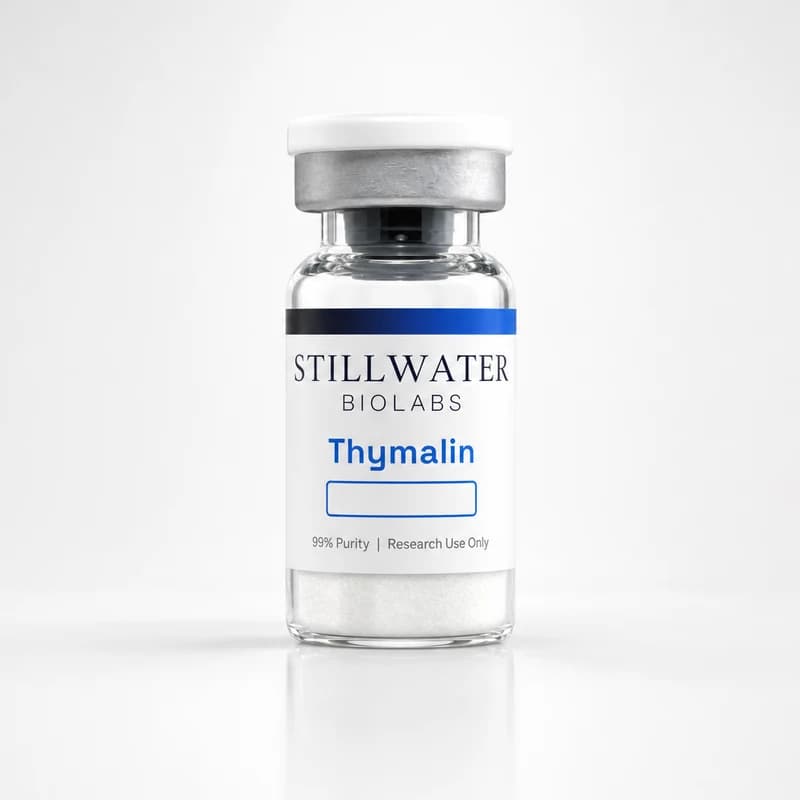
≥99%
62304-98-7
3108.27 g/mol
Thymosin Alpha-1
A synthetic 28-amino acid peptide modeled after a thymus gland sequence, studied for immune modulation.
Minimum order: 10 units per compound, across any mix of sizes.



Pay with Visa, Mastercard, or AMEX · ACH bank transfer saves 5%
Cold-chain shipping via UPS, with tracking provided. Freight and lead time are confirmed on your quote.
Third-party tested
Supplied to qualified labs and institutional buyers. Institutional use & buyer eligibility
Characteristics
| Property | Value |
|---|---|
| Molecular Formula | C₁₂₉H₂₁₅N₃₃O₅₅ |
| CAS Number | 62304-98-7 |
| Molar Mass | 3108.27 g/mol |
| Amino Acid Sequence | Ac-Ser-Asp-Ala-Ala-Val-Asp-Thr-Ser-Ser-Glu-Ile-Thr-Thr-Lys-Asp-Leu-Lys-Glu-Lys-Lys-Glu-Val-Val-Glu-Glu-Ala-Glu-Asn |
| Synonyms | Thymosin α1, Tα1, Thymalfasin, Zadaxin |
| Physical Form | Lyophilized powder |
| Solubility | Soluble in water and physiological saline |
| Organoleptic Profile | White lyophilized powder; odorless |
| Purity | ≥98% by HPLC |
| Storage Conditions | Store lyophilized at -20°C; reconstituted solution stable at 2-8°C for up to 10 days |
How is Thymosin Alpha-1 Used in Research?
Thymosin Alpha-1 (Tα1) is a 28-amino acid peptide originally isolated from thymic tissue by Goldstein and colleagues in the 1970s. It is an N-terminally acetylated, naturally occurring thymic peptide that plays a central role in immune-system maturation and regulation in research models. Tα1 has been characterized under the trade name Zadaxin as an immunomodulatory research reference compound, with historical investigation in chronic hepatitis B research models and as an adjunct in cancer immunotherapy research.
The immunomodulatory mechanism of Tα1 involves activation of Toll-like receptors (TLR2 and TLR9) on dendritic cells, leading to enhanced antigen presentation, T-cell priming, and maturation of functional T-helper and cytotoxic T-cell populations in preclinical systems. Research has demonstrated that Tα1 promotes the differentiation of CD4+ and CD8+ T-cells, enhances natural killer cell cytotoxicity markers, and increases the production of interferon-alpha and interferon-gamma in cell-culture models. The peptide also modulates inflammatory-marker responses by balancing pro- and anti-inflammatory cytokine markers in preclinical studies.
Extensive preclinical research has examined Tα1 in the context of viral-infection research models, including hepatitis B, hepatitis C, and HIV preclinical models. Studies have also investigated its use as an immune adjuvant in combination with cancer-vaccine and chemotherapy research protocols in preclinical settings. More recent research has explored its role in immune-reconstitution markers following hematopoietic stem-cell transplantation models and in modulating immune responses in immunocompromised research models.
This product is supplied in a lyophilized form and requires reconstitution prior to laboratory handling. For research and laboratory use only. Not for human or veterinary consumption.
Areas of Study
Immune Modulation
Activates dendritic cells via TLR2/TLR9 signaling, enhancing antigen presentation and T-cell priming for robust adaptive immune responses.
T-Cell Activation
Promotes differentiation and functional maturation of CD4+ and CD8+ T-lymphocytes and enhances natural killer cell cytotoxicity.
Viral Research
Extensively studied in hepatitis B/C models with clinical approval in multiple countries for chronic hepatitis B treatment.
Dendritic Cell Function
Enhances dendritic cell maturation and antigen-presenting capacity through Toll-like receptor activation pathways.
Cancer Immunotherapy Adjunct
Investigated as an immune adjuvant in combination with vaccines and chemotherapy to enhance anti-tumor immune responses.
References
- [1]Goldstein AL, Goldstein AL. (2009). From lab to bedside: emerging clinical applications of thymosin α1. Expert Opinion on Biological Therapy, 9(5), 593-608.
- [2]Romani L, Bistoni F, Montagnoli C, et al. (2007). Thymosin α1: an endogenous regulator of inflammation, immunity, and tolerance. Annals of the New York Academy of Sciences, 1112, 326-338.
- [3]Garaci E, Pica F, Rasi G, Favalli C. (2000). Thymosin α1 in the treatment of cancer: from basic research to clinical application. International Journal of Immunopharmacology, 22(12), 1067-1076.
- [4]Tuthill C, Rios I, McBeath R. (2010). Thymalfasin: clinical experience and future directions. Annals of the New York Academy of Sciences, 1194, 130-135.
- [5]Matteucci C, Grelli S, De Smaele E, et al. (2017). Thymosin alpha 1 and HIV-1: recent advances and future perspectives. Future Microbiology, 12(2), 141-155.
Disclaimer: The information provided is for research reference only and does not constitute medical advice. Products are sold strictly for in-vitro research use.
Certificate of Analysis (COA)
Third-Party Verified Quality
Every batch of Thymosin Alpha-1 is independently tested by an A2LA-accredited (ISO 17025:2017) third-party laboratory using HPLC-UV/VIS for purity and measured quantity. Each COA carries the lab's signed report and a batch-specific lot number. We publish these results publicly so you can verify exactly what you're getting.
View Lab Results