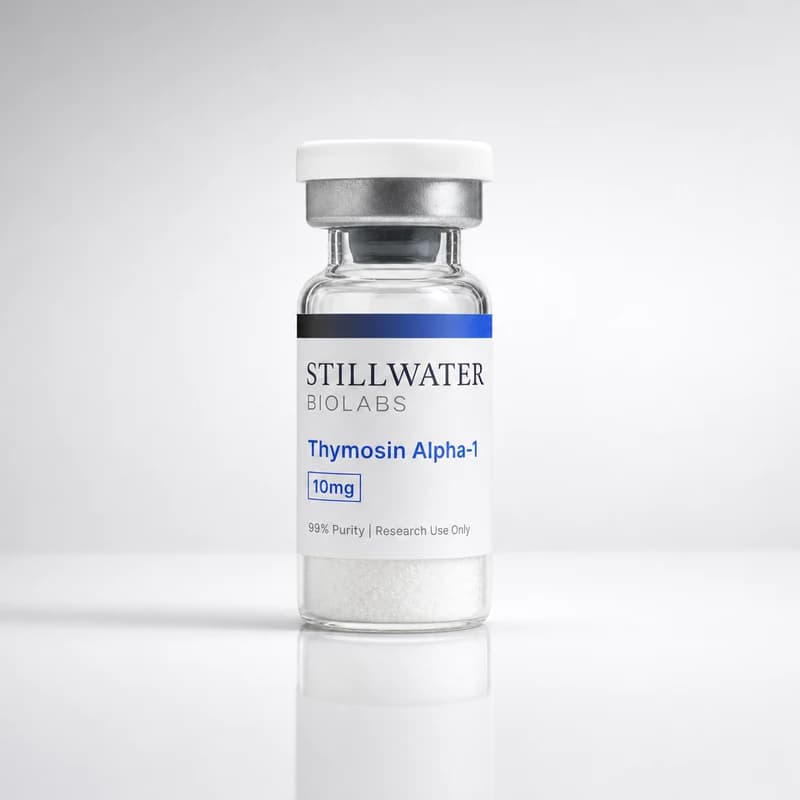
≥99%
63958-90-7
3108.50 g/mol
Thymalin
A thymic polypeptide hormone studied for immune system regulation and neuroendocrine function.
Minimum order: 10 units per compound, across any mix of sizes.



Pay with Visa, Mastercard, or AMEX · ACH bank transfer saves 5%
Cold-chain shipping via UPS, with tracking provided. Freight and lead time are confirmed on your quote.
Third-party tested
Supplied to qualified labs and institutional buyers. Institutional use & buyer eligibility
Characteristics
| Property | Value |
|---|---|
| Molecular Formula | Polypeptide complex (heterogeneous mixture) |
| CAS Number | 63958-90-7 |
| Molar Mass | ~3108.50 g/mol |
| Amino Acid Sequence | 32-amino acid thymic polypeptide |
| Synonyms | Thymalin, Thymus extract peptide, Thymic factor |
| Physical Form | Lyophilized powder |
| Solubility | Soluble in water and physiological saline |
| Organoleptic Profile | White to off-white lyophilized powder; odorless |
| Purity | ≥95% by HPLC |
| Storage Conditions | Store lyophilized at -20°C; reconstituted solution stable at 2-8°C for up to 7 days |
How is Thymalin Used in Research?
Thymalin is a polypeptide complex originally isolated from the thymus gland, developed by Khavinson and colleagues at the Saint Petersburg Institute of Bioregulation and Gerontology. It belongs to a class of bioregulatory peptides that have been studied extensively in Russian biogerontology research for their effects on immune system restoration and aging. Thymalin is composed of a mixture of short peptides derived from thymic tissue and has been investigated for its ability to restore thymic function and modulate immune competence in aging and immunodeficiency models.
Research has demonstrated that Thymalin influences T-cell maturation and differentiation markers in preclinical cell-culture systems. Studies in aged animal research models have shown shifts in thymic-architecture readouts and immune-cell research markers, including CD4/CD8 ratio profiles and natural-killer-cell activity panels. The peptide has also been investigated for its effects on neuroendocrine regulation, with studies suggesting modulation of melatonin production and circadian cortisol patterns.
Long-term observational studies conducted by Khavinson and colleagues have examined Thymalin's effects in elderly cohorts, reporting improvements in immune markers, cardiovascular parameters, and mortality indices over follow-up periods of up to 12 years. These studies, while primarily conducted within Russian research frameworks, have contributed to the growing field of bioregulatory peptide research in gerontology.
This product is supplied in a lyophilized form and requires reconstitution prior to laboratory handling. For research and laboratory use only. Not for human or veterinary consumption.
Areas of Study
Immune Regulation
Investigated for restoration of thymic function and normalization of T-cell subpopulations in aging and immunodeficiency models.
T-Cell Maturation
Promotes differentiation and functional development of T-lymphocytes through thymic microenvironment support.
Neuroendocrine Function
Studied for modulation of melatonin secretion and cortisol circadian patterns, suggesting thymic-pineal axis interactions.
Aging Research
Preclinical studies in aged animal models have examined effects on immune markers, cardiovascular parameters, and longevity indices.
References
- [1]Khavinson VK. (2002). Peptides and aging. Neuroendocrinology Letters, 23(Suppl 3), 11-144.
- [2]Khavinson VK. (2002). Peptides and Ageing. Neuroendocrinology Letters, 23(Suppl 3), 11-144.
- [3]Kuznik BI, Pateyuk AV, Baranchugova LM, Rusaeva NS. (2013). Thymalin and its role in immunomodulation. Advances in Gerontology, 3(4), 301-305.
- [4]Khavinson VK, Kuznik BI, Ryzhak GA. (2014). Peptide bioregulators: a new class of geroprotectors. Message 1: results of experimental studies. Advances in Gerontology, 4(4), 225-233.
Disclaimer: The information provided is for research reference only and does not constitute medical advice. Products are sold strictly for in-vitro research use.
Certificate of Analysis (COA)
Third-Party Verified Quality
Every batch of Thymalin is independently tested by an A2LA-accredited (ISO 17025:2017) third-party laboratory using HPLC-UV/VIS for purity and measured quantity. Each COA carries the lab's signed report and a batch-specific lot number. We publish these results publicly so you can verify exactly what you're getting.
View Lab Results